Mod Ecosystem: depth 10 of 10, grind 2 of 10.
The Steam Workshop provides thousands of community-created game mods, custom boards, assets, and rulesets.
Games > Tabletop Simulator
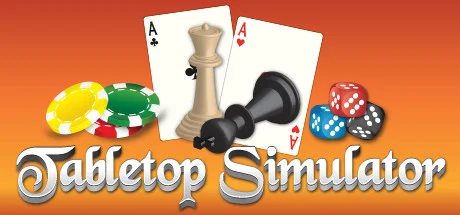 Now scanning App #286160
Tabletop Simulator functions as a physics-based digital sandbox engine designed to emulate board games, card games, and tabletop roleplaying sessions. It relies heavily on community-driven mods and multiplayer sessions to recreate authentic game nights online.
Tell the Lab which mechanics you love and which you avoid. This box then makes a Play or Dodge call for you on every game.
The Steam Workshop provides thousands of community-created game mods, custom boards, assets, and rulesets.
Players use a 3D physics sandbox to manipulate objects, roll dice, and build custom board games or layouts.
Groups gather online to play cooperative board games, card games, and tabletop roleplaying campaigns together.
Users regularly utilize the platform as a digital table to run ongoing tabletop roleplaying games and social game nights.
Friends and community members compete against each other in virtual adaptations of classic and modern competitive board games.
Community mods allow players to construct and test trading card game decks digitally.
Players use the engine to host and play tactical wargames and tabletop RPGs with turn-based rules.
Tabletop Simulator is a digital sandbox engine built around a massive mod ecosystem rated at depth 10, combined with sandbox creativity at depth 9 and co-op PvE at depth 8. The grind sits at 1 out of 10, meaning you only put in effort when you want to learn rules or set up boards. You will bounce off this if you expect single-player campaigns, automated rules enforcement, or built-in video game mechanics, because it simply emulates physical tabletops with physics objects and community-driven content. If you want a virtual space to host game nights, run tabletop roleplaying campaigns, or test trading card game decks with friends online, this provides the exact tools needed to replicate a physical table.
Its deepest systems are mod ecosystem (10/10), sandbox creativity (9/10) and co-op PvE (8/10).
Play Tabletop Simulator if you want a digital space for weekly game nights; you love browsing endless community-made mods; or you play tabletop RPGs with remote friends.
Skip Tabletop Simulator if you expect automated rules and turn enforcement; you want single-player content with a story; or you hate dealing with clumsy physics objects.
Not much. Its highest grind score is 2/10, for mod ecosystem.
It has no precision & skill difficulty, build customization, open-world exploration, story-driven, environmental storytelling and lore depth.
By shared mechanics rather than genre, the closest matches are Grand Theft Auto V Legacy (72% match), Garry's Mod (71% match) and Grand Theft Auto V Enhanced (67% match).
Steam lists these modes: Single-player, Multi-player, PvP, Online PvP and Shared/Split Screen PvP.
The minimum listed on Steam is: Processor: SSE2 instruction set support.; Memory: 4 GB RAM; Graphics: Graphics card with DX10 (shader model 4.0) capabilities.; Storage: 3 GB available space.
It is listed at $19.99 on the US Steam store, checked 19 November 2026.
No takes yet. Be the first.
Also checkKinguin
Lowest ever seen: $7.99 Price data from IsThereAnyDeal. Prices change often; the store page has the final one.
 72% match
 71% match
 67% match
 64% match
 64% match
 64% match
 64% match
 63% match
Store details, review counts and requirements come from Steam. Community tag votes come from SteamSpy, and themes and modes from IGDB. Depth and grind scores are produced by two separate language models reading that material, then reconciled and capped against community tags. A score the two models disagree on is marked low confidence.