Story-Driven: depth 10 of 10, grind 5 of 10.
An emotional and philosophical narrative unfolds across multiple playthroughs and distinct endings featuring android protagonists 2B, 9S, and A2.
Games > NieR:Automata™
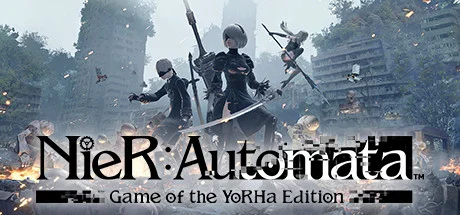 Now scanning App #524220
NieR:Automata is an acclaimed action RPG blending fast hack-and-slash combat with a deep, philosophical story told across multiple playthroughs. Players guide android protagonists through a ruined world while experiencing a rich soundtrack and unconventional narrative shifts.
Tell the Lab which mechanics you love and which you avoid. This box then makes a Play or Dodge call for you on every game.
An emotional and philosophical narrative unfolds across multiple playthroughs and distinct endings featuring android protagonists 2B, 9S, and A2.
Fast and stylish hack-and-slash action combat forms the core of the player's encounters against hostile machine lifeforms.
Memorable multi-phase boss fights punctuate the narrative across different gameplay styles.
The game deeply integrates its themes of existence and identity into its gameplay mechanics, world design, and musical score.
Multiple major playthrough routes and sequential lettered endings drastically change the story perspective.
Extensive weapon stories, archives, and environmental details flesh out a philosophical post-apocalyptic lore.
Players customize their android combat performance and abilities using plug-in chips acquired throughout the journey.
Normal and hard modes require responsive dodging and timing against aggressive attacks.
Players navigate a ruined, post-apocalyptic open world as android soldiers, though the terrain can occasionally feel sparse.
Plug-in chips allow players to customize passive and active abilities within a memory capacity limit.
AI-controlled companion androids assist the player in combat and dialogue throughout the journeys.
Revisiting areas across multiple playthrough routes and unlocking new traversal capabilities opens up the world.
Ranged combat using pod shooting provides a minor option alongside primary hack-and-slash action.
Pod programs act as token ranged special attacks rather than a full spellcasting system.
Weapons and plug-in chips drop from enemies or are purchased, offering straightforward stat variations.
Traversal involves jumping across ruins, climbing ladders, and utilizing gliding mechanics.
Occasional dialogue prompts allow minor branching or flavor responses without deep RPG consequences.
Hacking minigames provide brief top-down twin-stick shooting puzzles to solve.
Players can ride wild animals across the open world as simple mounts.
Enemies can occasionally be approached without immediate alert, but stealth is extremely basic.
Resistance camp members function primarily as quest givers and shopkeepers rather than managed settlers.
Death results in the loss of chips unless the player retrieves their dead body from where they fell.
A specific joke ending can cause data loss, but true permadeath is not a core part of the game design.
Certain missions feature optional timers or rapid escape sequences.
Musical elements tightly integrate with presentation, though rhythm input is not a core gameplay loop.
Asynchronous online features let players recover fallen player bodies as temporary AI allies.
Community visual and performance mods exist on PC.
Flight unit segments shift the game briefly into a bullet hell shoot-em-up perspective.
Materials and items are scavenged from containers and defeated machine parts in the open world.
Vendors buy and sell basic items, chips, and weapon upgrade materials.
Some environmental details react to player actions, but systemic simulation is minimal.
Post-apocalyptic ruins and creepy machine behaviors evoke mild atmospheric tension.
You guide android protagonists through a ruined world using fast melee combat sitting at a depth of 8 and a grind of 3. The narrative unfolds across multiple playthroughs with a story-driven depth of 10 and a grind of 5, supported by branching narrative mechanics at depth 8 and grind 3. You will experience extensive lore and environmental storytelling both rated at depth 8 with a grind of 2. You will bounce off this experience if you dislike repeating gameplay sections to uncover sequential lettered endings or if you expect traditional open-world exploration, which sits at a depth of 5 and a grind of 4 in a sparse post-apocalyptic setting.
Its deepest systems are story-driven (10/10), melee combat (8/10) and boss encounters (8/10).
Play NieR:Automata™ if you want a story driven across multiple playthroughs; you enjoy fast and stylish hack and slash combat; or you like discovering deep philosophical lore.
Skip NieR:Automata™ if you dislike repeating content for new endings; you want a dense and lively open world; or you prefer straightforward single play-throughs.
Moderately. The most repetitive part is story-driven, at 5/10 for grind.
It has no competitive PvP, sandbox creativity, base building, social & roleplay, procedural generation and survival needs. It only touches on co-op PvE (1/10), resource gathering (1/10), mod ecosystem (1/10), economy & trading (1/10), time pressure (1/10) and horror & tension (1/10).
By shared mechanics rather than genre, the closest matches are The Witcher 2: Assassins of Kings Enhanced Edition (86% match), God of War (85% match) and The Witcher 3: Wild Hunt — Remastered (85% match).
Steam lists these modes: Single-player.
The minimum listed on Steam is: Processor: Intel Core i3 2100 or AMD A8-6500; Memory: 4 GB RAM; Graphics: NVIDIA GeForce GTX 770 VRAM 2GB or AMD Radeon R9 270X VRAM 2GB; Storage: 50 GB available space.
It is listed at $39.99 on the US Steam store, checked 19 November 2026.
No takes yet. Be the first.
Also checkKinguin
Lowest ever seen: $13.99 Price data from IsThereAnyDeal. Prices change often; the store page has the final one.
 86% match
 85% match
 85% match
 84% match
 82% match
 82% match
 82% match
 82% match
Store details, review counts and requirements come from Steam. Community tag votes come from SteamSpy, and themes and modes from IGDB. Depth and grind scores are produced by two separate language models reading that material, then reconciled and capped against community tags. A score the two models disagree on is marked low confidence.